Saturday, August 27, 2016

Here's a brief summary for my two chapters in Game Engine Gems Volume 3 on developing a framework for building a behavior model that can be be used for programming contextually adaptable game agents. 

Chapter One - A Control System Based Approach to Entity Behavior

Character control and artificial intelligence.

This chapter focuses on a hierarchical control system to model an entity’s AI. While many games’ AI appear to exhibit nothing more than a simple stimulus and response mechanic, more robust behavior can be crafted through the use of control systems, ideally resulting in more compelling game play. Instead of coding for specific behaviors that may break under unknown game situations, we compose a hierarchical architecture of negative feedback systems to minimize disturbances between the entity and the environment, allowing it to exhibit purposeful behavior, even when those
disturbances may be unknown.

And there is also a second chapter that further enhances the base character control framework described above.

Chapter Two - A Control System for Enhancing Entity Behavior 

We’ve all seen games where an alien soldier is running down a hallway, and as
that soldier reaches the end of the hallway, he starts to blend in a turn animation
to change his direction but ends up careening into a wall! Sure, we could have the
level designer make the hallway wider in a vain attempt to fix the problem, but
the real problem is that we’re mixing statically generated assets with behavior
that’s driven or influenced by the game player. We need entities that can react to
these types of situations, and one of the mechanisms that can help us modify that
soldier’s behavior is by taking feedback into consideration in an entity’s control
architecture.

Control and feedback are everywhere in our everyday interactions with the
real world. We perceive and act according to a myriad of feedback from ourselves and the environment as well as social cues. One of the essential understandings we want to achieve is that we want to influence an entity’s behavior specifically by its own output, rather than just brute world queries. We are seeking reliable behavior. Feedback within a control system is essentially perceiving or receiving suggestions about an action that we’ve performed within a specific set of contextual extents and using them in a manner that appropriately modifies an entity’s behavior. What this chapter shows is how we can use a proportional integral differential (PID) controller to influence our entity’s behavior through negative feedback.

Buy it here: Game Engines 3 purchase link

Chapter Three - A Basic Learning Model for Entity Behavior Based On a Control System (WIP)

This chapter focuses on a storage, retrieval and comparison mechanism for categorizing control system disturbances that may be used and adaptively modified in similar contexts.

Sunday, October 27, 2013

Game AI Pro: Collected Wisdom of Game AI Professionals


A couple of brief snippets that provides an introduction to my chapter on developing a framework for building a behavioral model that can be be used for engineering virtual animals or really any in game agent.

A Control-Based Architecture for Animal Behavior

Many games include creatures or animals that exhibit the illusion of life while interacting with the game player and with the world around them. This illusion breaks when a creature does something that seems out of character or unnatural – and these types of breaks in the illusion are unfortunately all too common. Thus we need to provide the ability for our characters to exhibit believable behavior that is purposeful, while being robust enough to appear fully life-like.

... if our behavior is going to be believable then it needs to be more than just the output from a behavior tree or other AI architecture. It requires a system which can deliver the appropriate interactions regardless of the ever-changing situation in-game. If purposeful behavior is going to be believable then it must produce consistent results regardless of varying environmental conditions. This is something that real-world creatures typically handle without much thought, but for an AI character it can be quite hard.

... this chapter provides an introduction to aspects of controller theory that can be used to implement a behavioral system for life-like animals.

Sample Sources/Inspiration

[Hediger 1955], Heini Hediger, Studies of the Psychology and Behavior of Animals. New York: Criterion Books.
[James 1890 ], William James, The Principles of Psychology.,New York: Dover Publications.
[Lorenz 1981], Konrad Lorenz, “The Foundations of Ethology.” New York: Simon and Schuster.
[Powers 1989], William Powers, Behavior: The Control of Perception. New Canaan: Benchmark Publications.
[Ramsey 2009-A] Michael Ramsey, “A Unified Spatial Representation for Navigation Systems.” Proceedings of the Fifth AAAI Artificial Intelligence And Interactive Digital Conference, 2009,
pp.119-122.
[Ramsey 2009-B] Michael Ramsey, “A Practical Spatial Architecture for Animal and Agent Navigation.” Game Programming Gems 8, edited by Adam Lake. Boston:Charles River Media, 2010.
[Ramsey 2011] Michael Ramsey, “An Egocentric Motion Management System.” Game Engine Gems 2, edited by Eric Lengyel,
[Toda 1982] Masanao Toda, Man, Robot and Society:Models and Speculations. Martinus Nijhoff Publishing, 1982.

Sunday, October 06, 2013

Wargaming books, old and new

Interestingly enough since my post about my new AI project - Declaration of Empire(DOE), I've received inquiries asking which books I've found useful in the development of DOE. Instead of listing a bunch of books - here's a picture of some books that have influenced my endeavors both directly as well as simply providing motivation from the early 1960's and 1970's (some of these are reprints courtesy of John Curry's wargaming history efforts - highly recommended).

DOE will include a write-up that includes sources of inspiration for the project. More books to come.

Friday, September 27, 2013

A Tribute to Stellar Conquest via Declaration of Empire

I've been a wargamer my entire life. I enjoy CRT's, shifts, grain analysis, establishing defensive lines, etc. So here's my long overdue tribute to what I consider one of the best games from the 1970's.  I've been putting together this little AI project (Declaration of Empire) as a side project while I develop the technology for a chapter I provided for Game AI Pro: Collected Wisdom of AI Professionals. It's a tribute to Stellar Conquest (Metagaming 1979).

In short it's "A game in which four alien societies invade an unknown section of the galaxy. Each player accepts control of an expeditionary force, which they will grow into an interstellar empire."

While the Declaration of Empire (DOE) has similarities to Stellar Conquest, DOE's AI is quite interesting in that while developing it over the 2013 summer, I've used my accumulated archive of every Stellar Conquest article since the early 1970's to craft the underlying strategies. These articles coupled with some technology that I've developed for the AI engine simply entitled Noumena, make for a game that is challenging and (I'm happy to say) yields a number of late game surprises.

While DOE is being written on a Windows system, it should be fairly straight forward to recompile DOE for either MacOS or Linux with the eventual availability of DOE on Android and IPad tablets. I haven't worked out the distribution method for the initial desktop releases, but it should be reasonable if not almost free.


Wednesday, December 28, 2011

An Egocentric Motion Management System - article excerpt from Game Engine Gems 2

Google Books has provided a generous preview of my chapter from Game Engine Gems 2 describing a character movement solution - aspects of which I used in World of Zoo (PC & Wii). The character movement solution was also used in several demos - including a prototype of a non-zoo type game. The chapter contains a detailed write-up of how how to integrate the character movement system with a behavioral model that conveys perceived intent (section 19.9 A Single Agent Behavioral Response Algorithm and Example). The link to the article is below - enjoy!

An Egocentric Motion Management System Summary

The egocentric motion management system (ECMMS) is both a model for agent movement and an application of a behavioral theory. Any game that features agents (e.g., animals, soldiers, or tanks) that move around in a 3D scene has a need for an agent movement solution. A typical movement solution provides mechanisms that allow for an agent to move through a scene, avoiding geometry, all the while executing some sort of behavior. This article discusses not only how focusing on the agent drives the immediate interactions with the environment but also, more importantly, that by gathering some information about the environment during locomotion, we gain the ability to generate spatial semantics for use by the agent’s behavior system. Portions of the ECMMS were used in a cross-platform game entitled World of Zoo (WOZ). WOZ is an animal simulator that requires various zoo animals to move through their environments in an incredibly compelling manner while the  players constantly alter the environment. So the proving ground for this system was in an environment that could be changed around the agents at any particular moment. In addition to detailing ECMMS I also discuss how to build a unified behavioral model that utilizes technology from all three of my character movement articles.


An Egocentric Motion Management System - Theory and an Implementation

Tuesday, December 13, 2011

Qualitative Improvements of Biasing a Routes Starting Position


In this note I'll be discussing how biasing an entities starting position before providing it to the pathfinder, can improve the qualitative behavior of your game's characters. This technique was used on a multi-platform game [Ramsey 2009a].

Generating a route to destination can be parametrized in many ways, but one of the most fundamental parameters has a trickle down effect attune to an avalanche with observable repercussions on an entities motion - if selected incorrectly.

What I'm suggesting is that the start position provided to the path finder is one of the most important parameters to get correct. It almost seems intuitive to suggest that the starting point is "where your at." Well, maybe not so - we need to think temporally. Consider not only our thoughts, but our movement - it's always changing, adapting and what's appropriate at this moment in time is not necessarily appropriate 5 seconds from now, probably not even one second in the future. This applies to selecting a starting position for our animating penguin. We are more interested where it'll be rather then where it's at currently.

The picture below illustrates a simple environment where we have a penguin that wants to move from position A to position B. A typical pathfinder would be supplied with the penguins current position as the start position, and position B as the end point. The problem with this seemingly correct solution is that it fails to factor in any forward momentum of the penguin. Whether the forward momentum is implicit in the animation driving the penguin or an associated movement rate of a simple sprite where the penguin is at (t) is not where it'll be at (t+1).

The penguins directional vector is represented by the light blue line, the pink segments is the path returned if the penguins current position is used as the starting point, and the green segments is the route when we factor in not only the penguins directional vector, but also it's velocity. The yellow bidirectional connections is the graph representation of the navigation mesh.

Depending on how fast the penguin is moving, we bias the start position of the penguin farther and farther away. A simple technique is to attain the penguins heading and magnitude of translation over one frame (t). And then using a standard unit of measurement (r) - I used the diameter of the penguin, you multiply (r*t) = (s). I also experimented with the radius and this worked as well for animals that didn't translate too fast. (s) then becomes a scale that we can apply to the penguins directional vector, with a resulting point in the environment that serves as the starting point for your path finding algorithm. Straightforward and it allows for the continuation of the penguins motion with out any jarring hitches caused by the pathfinder (I had coded up a modified version of A-Star that supported our modeling methods) .

This technique is not only useful in this directed graph representation, but also on typical grids and navigation meshes. I hope you find it useful as using this technique had a qualitatively positive impact on the movement of the animals in World of Zoo.

References
[Gibson 1986] James J. Gibson. The Ecological Approach to Visual Perception. Hillsdale,
NJ: Lawrence Erlbaum Associates, 1986.

[Ramsey 2009a] Michael Ramsey. “A Unified Spatial Representation for Navigation
Systems.” Proceedings of The Fifth AAAI Artificial Intelligence and Interactive
Digital Entertainment Conference, 2009, pp. 119–122.

[Ramsey 2009b] Michael Ramsey. “A Practical Spatial Architecture for Animal and
Agent Navigation.” Game Programming Gems 8, edited by Adam Lake. Boston:
Charles River Media, 2010.

[Ramsey 2009c] Michael Ramsey. “An Egocentric Motion Management System.” Game Engine
Gems 2, edited by Eric Lengyel. Natick: A.K. Peters, 2011.

Further Reading
1. “On the Nature of Things” Lucretius, translated by Ronald Melville is wonderful book expounding the atomic theory first presented by Epicurus. Book I covers the two principles of beingness: that nothing ever came from nothing and that nothing ever returns to nothing. Book 2 discusses the principles of continual motion and how collisions shape the free will. Book 3 covers the nature of the mind, while Book 4 explains the nature of vision, hearing, taste, smell and how aspects of the environment enter the mind. Book 5 and 6 wrap covering mortality and environmental effects.

Friday, December 02, 2011

Noumena Philosophical Canon


While the last post attempted to cover the more concrete canon, this post will list the books that comprise my Noumena philosophical canon. Every project needs an underlying set of principles that help guide the development of not only the final product, but arguably the process in which these systems were built. These books represent some of the core books that provided ideas that contributed to Noumena's process.

1.  The Complete Works of Aristotle, ed. Jonathan Barnes
2.  The Human Touch, Michael Fray
3.  Michel De Montaigne The Complete Works, Translated by Donald Frame
4.  The Phenomenom of Life, Alexander
5.  On the Nature of Things, Lucretius
6.  Being and Time, Heidegger
7.  The World of Perception, Merleau Ponty
8.  Experience and Prediction, Hans Reichenbach
9.  The Phenomenology of Perception, Merlau Ponty
10. The Origins of Knowledge and Imagination, Jacob Bronowski

Noumena Canon

It's been a while since I posted, so here are a few of the books that I consider canon for the development of Noumena. There are literally hundreds of other books that have influenced Noumena in some form or another (I actually posted several years ago an initial list of some of the books) but these few here are the pillars on which a number of my ideas are based upon.


1.  The Philosophy of Animal Minds, ed. Robert Lutz
2.  Animal Cognition, Clive Wynne
3.  Mental Leaps, Keith Holyoak and Paul Thagard
4.  Mindreading Animals, Robert Lutz
5.  Incomplete Nature, Terrence Deacon
6.  Creating a Memory of Causal Relationships, Michael Pazzani
7.  Who Needs Emotions?, ed Jean-Marc Fellous and Michael Arbib
8.  Behavior: The Control of Perception. William T. Powers
9.  General System Theory. Ludwig von Bertalanffy
10. The Principles of Psychology, Volumes 1 & 2, William James.

Hopefully in the not too distant future, I'll be posting an outline for the manuscript entitled, "Fellow Creatures: A Referential Intelligence." It's a book that covers the development of the referentially based cognitive engine, Noumena.


Tuesday, July 05, 2011

AI Papers, Books, and Conference Publications

I've received some emails from individuals looking for some of my work (specifically my articles and papers on character motion management), so here is a list of some my published works with a brief note and what books/journals/conferences they can be found in - as well as a few extra early game programming works.

The chapters in Game Engine Gems 2, Game Programming Gems 8, and the paper presented at the Artificial Intelligence and Interactive Digital Entertainment Conference 2009 form the three major sources for the some of my work on character movement systems. Together they form a unique approach that combines AI, animation and physics into a unified architecture that provides a description of the background to, principles of, and the development of an approach to implementing a character behavioral system.

For Game Engine Gems 2, I provided a chapter entitled, An Egocentric Motion Management System. The egocentric motion management system (ECMMS) is both a model for agent movement and an application of a behavioral theory. Any game that features agents (e.g., animals, soldiers, or tanks) that move around in a 3D scene has a need for an agent movement solution. A typical movement solution provides mechanisms that allow for an agent to move through a scene, avoiding geometry, all the while executing some sort of behavior. This article discusses not only how focusing on the agent drives the immediate interactions with the environment but also, more importantly, that by gathering some information about the environment during locomotion, we gain the ability to generate spatial semantics for use by the agent’s behavior system. Portions of the ECMMS were used in a cross-platform game entitled World of Zoo (WOZ). WOZ is an animal simulator that requires various zoo animals to move through their environments in an incredibly compelling manner while the  players constantly alter the environment. So the proving ground for this system was in an environment that could be changed around the agents at any particular moment. In addition to detailing ECMMS I also discuss how to build a unified behavioral model that utilizes technology from all three of my character movement articles.

In Game Programming Gems 8, I've written an article detailing the World of Zoo's navigation system's architecture; as well as provided some general thoughts on developing a motion management system. The article is entitled, A Practical Spatial Architecture for Animal and Agent Navigation. This article is a nice bookend to the AIIDE 2009 paper (the Game Gems article provides more concrete insights, while the AIIDE paper is more algorithmic).

Here's a brief introduction to the article: Game literature is inundated with various techniques to facilitate navigation in an environment. However many of them fail to take into account the primary unifying medium that animals and agents use as locomotion in the real world. And that unifying medium, is space [Lefebvre97]. The architectonics of space relative to an animals or agent’s motion in a game environment, is the motivation for this article. Traditional game development focuses on modeling what is physically in the environment, so it may seem counterintuitive to model what is not there, but one of the primary reasons for modeling the empty space of an environment is that it is this spatial vacuum that frames our interactions (be it locomotion or a simple idle animation) within that environment. Space is the associative system between objects in our environments.

This article will discuss this spatial paradigm and the techniques that we used during the development of a multiplatform game, entitled World of Zoo (WOZ). WOZ was not only a challenging project by any standard definition of game development, but also because we desired our animals motion to be credible.


An important aspect of any animal’s believability is that they are not only aware of their surroundings, but that they also move through a dynamic environment (Color Plates 1 and 2 contain examples of WOZ’s environment) in a spatially appropriate and consistent manner. This maxim had to hold true whether the animal was locomoting over land, water or even through air! To help facilitate the representation of our spatial environments we used several old tools in new ways, and in conjunction with a few inventions of our own, we believe we accomplished our goals.


This peer reviewed paper outlines the general philosophy of a unifying paradigm for navigation systems. The paper is entitled, A Unified Spatial Representation for Navigation Systems and was presented at the Artificial Intelligence and Interactive Digital Entertainment Conference 2009 held at Stanford University.


Abstract

The purpose of this paper is to outline the core components of a practical navigation system which uses a novel technique for spatial representation in a commercial entertainment product. This paper is based upon thenavigation system developed for The World of Zoo (WOZ) by Blue Fang Games, LLC and published by THQ. WOZ placed the following requirement on our in game agents
(which are animals, such as tigers and penguins): depending on the animals species they were required to locomote across land, water, exhibit the ability to climb and eventually to fly all in a seamless manner. Animal locomotion in WOZ is driven by accumulating the root motion of multiple blended animations; this required a unique approach to the spatial representation of our environments. The system needed not only to take into account the defacto static environments that were created by
the level designers, but also the dynamic structures that the animals use (depending on the players interactions at that particular moment).


There was also the extra challenge of a system that was as straightforward as possible for level designers to work within. As Anthony J.D' Angelo so succinctly stated, "Don't reinvent the wheel. Just realign it." It is with this sage advice in mind that we reevaluated traditional navigable representations, in conjunction with how our animals should move through their environments. As important as the navigation framework was to the development of WOZ, the way the thought processes developed preceding the implementation is also of interest; as the re-understanding of what navigation is composed of (in virtually any environment) guided our decisions through the design and implementation stages.


In Game Programming Gems 7, I've written an article detailing the architecture of a multi-platform threading engine. The article is entitled, The Design and Implementation of Multi-Platform Threading Engine. One of the most important aspects of designing a multi-threaded program is spending the time upfront to design and plan your game architecture. Some of the high-levelissues that need to be addressed are: task dependencies, data sharing, data synchronization, acknowledgement and flow of data access patterns, decoupling of communication points to allow for reading but not necessarily writing of data, and minimizing event synchronization. This article details the GLRThreading Engine and also provides a lot of practical advice for either using the GLRThreading Engine or writing your own. Other topics include dealing with cache issues, thread pools, execution properties and more.
 
In Game Programming Gems 6, I've written an article about the Quantified Judgement Model (QJM) and it's usage and application to strategic game development. The article is entitled, Using the Quantified Judgement Model for Engagement Analysis. The Quantified Judgment Model (QJM) is both a model and a theory of combat. Originally developed to simulate historical battles and then later upon further refinement, used for modern engagement prediction; it is an ideal system for predicting potential victors in a game. In this gem I describe the base QJM formula. The base QJM formula can then be furthermore expanded upon, by adding models calculating attrition factors, spatial effectiveness of units and casualty effectiveness.

There is also some notes on the difference between the Lanchester equation and the QJM.


In AI Programming Wisdom Volume 2, I've written an article on Multi-Tiered AI Frameworks (MTAIF). This is the new framework used in the current iteration of Master of the Empire. The article is entitled, Designing a Multi-Tiered AI Framework. The MTAIF allows an AI to be broken up into three concrete layers, strategic, operational and a tactical layer. This allows for an AI programmer to have various AIs focus on specific tasks, while at the same time having a consistent overall focus. The MTAIF allows for the strategic layer to be focused exclusively on matters that can affect an empire on a holistic scale, while at the operational level the AI is in tune with reports from the tactical level. A differing factor from many other architectures is that the MTAIF does not allow decisions to be made on a tactical scale that would violate the overall strategic policies. This in turn forces highlevel strategic policies to be enforced in tactical situations, without the AI devolving into a reactionary based AI.


In Game Gems 5 I've written an article entitled, Advanced AI Framework Development with a Parallel Virtual Machine (PVM).
Its forms the fundamental understanding that is needed to start developing a parallel AI system. The article had to fit into 12 pages or so, so that meant a lot of actual implementation details had to be left out, as well as information on potential
design fallacies that may occur.


Early papers.

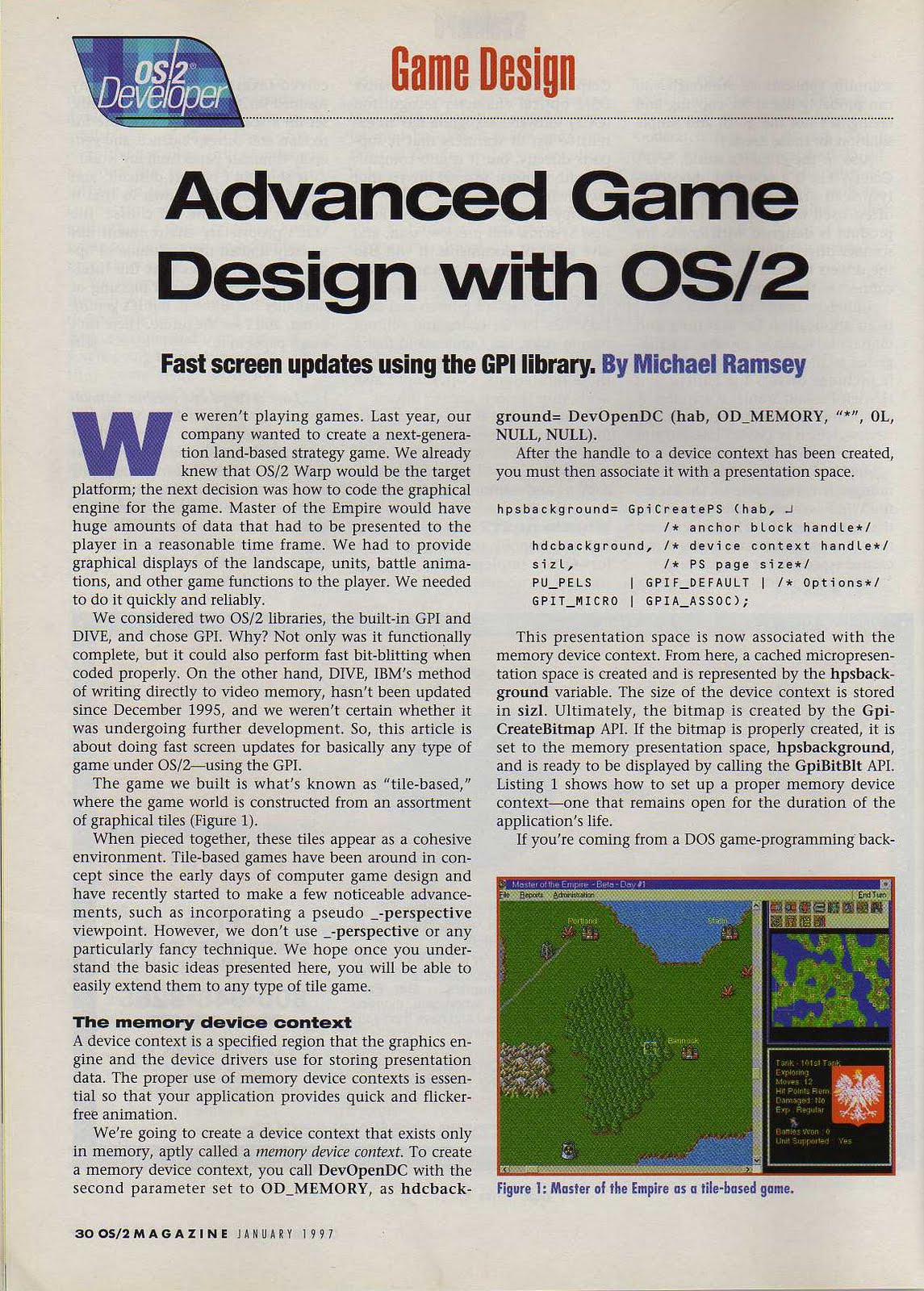
This is an article I wrote for OS/2 Developer entitled, Advanced Game Design with OS/2. The use of was the editor's idea. The article provided a basic summary of doing fast GPI updates - the technique I used for Master of the Empire. Obviously a super dated article (as it was published in 1997), but nonetheless it provides an interesting cross-section of my background.


Genericized Object Management (GOM). Todays games have huge AIs, being worked on by multiple programmers. Unless a new technique is introduced when the project begins, it becomes difficult to add any new type of methodology to the framework. This comes from the concern of breaking a currently implemented system or the real world fact that the new technique is just too complex. What the Genericized Object Manager (GOM) allows for is a simple way to register multiple objects through a parameterized functor [Alexandrescu02], which can then be easily accessed at runtime through one central core routine. A benefit of GOM is that the implementation can fit into almost any preexisting framework, so your game can have the immediate gains without refitting your framework to a particular solution. The GOM technique allows for setting up a specific AI, such as a particular Field Manager (see Designing a MultiTiered AI Framework), input managers, state machines that need to deal with multiple behaviors, or just a central system that is needed because the programming team is large. GOM also serves as a good technique while refactoring a large codebase.

Sunday, July 03, 2011

Emotions and Goals within Noumena

Emotions and Goals within Noumena
Started working on what in essence can be viewed as the emotional system for Noumena.
Appraisal module defined:
  1. Relevance of event
  2. Implications or consequence of event
  3. Can I cope w/the event?
  4. What is the significance of the event? To me? To allies?
Event defined: An externally observed phenomenon or an internally generated construct. E.g An opponents critter on your island – it's an event because it violates your perceived "ownership" of the island.
Events generated from violated self evident principles, e.g. A sense of ownership is definitely psychological in nature – another attribute for the RI psych profile. Ownership increases the perceived value of an object and this would actually be an excellent attribute of an RI to exhibit, because it not only factors into the immediate decisions but it would also allow for the RI to essentially want to exhibit behaviors such as: protect it's owned areas, retake objects taken by an opponent, and this could play into the more emotional aspects such as revenge, distrust, irritation etc. All emotional characteristics we want the RI to exhibit – naturally, if possible.

Goal Creation
Initially I'll create goals through the use of the concept of ownership – in MOTE this is initially the guide to goal creation.

A sense of ownership is one potentially just one element of an RI's personality.

Through the application of personality filter I could define other "desirable" personality components, e.g. Experimental or curious. These components could influence exhibited behavior – disproportionately.

Ownership questions:
  1. What do I currently own?
  2. What do I need to own?
  3. What should I own next?

As a game progresses from an opening mode, to a mid-game and finally to an endgame mode, the area of focus for these questions moves from an immediate focus to more distal concerns (e.g. Complexes, resources, farther away from the starting area).

Creating and Evaluating Goals With Respect to Ownership
Evaluation of tanks takes into consideration spatial relativity of the goal, with respect to concerns. E.g If a goal is at the bottom of the map – the RI should factor in strategies and tactics using that space, as well as the relational links of the cogents in between the start and destination when determining an appropriate response or series of responses.

Evaluation defined means a potential response or means to achieve that goal (perhaps suggesting that this is a plan) -> I dislike using the word plan as it has too much baggage.
The RI will need multiple methods of evaluating for and generating ownership.
Also need to establish why this region belongs to me, perhaps simple rules such as: my complex is on the island, or I need to expand – basically forms of justification.
Also need to be able to generate a concern for "trespassers" in an owned region. A couple examples should help here: An enemy simpleton on a large island would most likely cause little military concern, however a large group of tanks offloaded onto your island would probably matter! An aspect that would need to be considered is also the size of the land mass as that would influence the immediacy of the response as well as the overall strength of the response.
This is interesting because at a very fundamental level this seems a lot like an influence map – still, the influence map needs to be analyzed and evaluated to determine a response.

Saturday, July 05, 2008

My desktop and a few notes.

Recently I've added support for cognitive entities - these are the internal manifestations of the information/events/objects that are perceived from the environment. This allows for the engine to makes decisions that are not directly tied to the environment, but however can be related to the environment at a later time.


Books that have recently solidified some of the approaches take within the Noumena Cognitive Engine are:
Understanding Understanding by Heinz Von Foerster
Cybernetics of Cybernetics
Cybernetics and Human Knowing
Understanding Systems
Models of Thought by Herbert Simon
An essay, "Human Chess Skill", by Neil Charness. This essay is excellent in that Charness describes the approach that humans take to solving problems (obviously relative to chess) - via an understanding of visual perception, memory and evaluative mechanisms.

Friday, February 15, 2008

Environmental Stabilization


One of the paper's that I've read lately is called: "The Stabilization of Environments" by Hammond, et al. One of the underlying premises is that agents/humans adapt their environments to suit THEIR needs. It's a fascinating paper, covering a lot of the variable bits and pieces that many papers neglect or skirt around. The part that I enjoyed the most is the analysis bit - where there are concrete examples of an agent adapting the environment; as well as an almost how-to of stabilizing behaviors. I found the paper in "Computational theories of Interaction and Agency", edited by Philip Agre.

Work has also been progressing on the Noumena, here is a latest screen capture - I hope to show a capture of the Noumena debugger in short order. It's a bit more entertaining to see how the flow of perceived and generated information as it occurs in the cognitive engine.

Wednesday, January 02, 2008

A Toy Universe for the NoumenaMind Cognitive Engine : Master of the Empire - Express

I'm a huge proponent of doing something, rather than talking about it.

So for the past 2 months I've spent the majority of my leisure time working on two items: First and foremost the Noumena Cognitive Engine and secondly a toy universe (of sorts) that will allow for a demonstrable application of the cognitive engine; and that toy-universe is through the next iteration of MOTE.

The game by design is simple, yet addictive. Each player starts off with a capital and attempts to conquer the randomly generated worlds through the use of Simpletons, Infantry, Panzer Troopers and Tanks. There are no air or water units - that will come in a later version because this first iteration needs to be, not only a fun game, but it also has to serve as a test bed for the initial implementation and integration of the Noumena cognitive engine. There enough moving parts.

Certain terrain features restrict movement of particular unit types, resources are required to build certain units - so there is an artificial economy within this toy universe; one that Noumena must learn to use. Just having an AI engine just "do something" is relatively easy - if you want your solution to be brittle. By brittle I mean a solution that is generally not applicable to other similar contextual situations. The internal foundation and framework of Noumena make use of several weak methods - weak methods are used to solve problems (heuristically) in a context independent manner.

The cognitive engine needs to understand that the reason it moved the Panzer Trooper to counter a Tank inside a mountain pass is because it confined the movement of the Tank, allowed it's units to be concealed, allowed for disproportionate amount of offensive to be administered and at a higher cognitive level to be able to understand that this situation can be used as a cognitive frame for other situations that contain similar associative patterns. (This is not unlike similarities that maybe found within Selfridge's Pandemonium model - you can find the initial paper inside Neurocomputing: Foundations of Research as well as a further exposition inside Computer and Thought - under Pattern Recognition.)

The next steps are to solidify some of the human - toy universe interactions and then continue forth on with the integration of Noumena Cognitive Engine.

Saturday, November 10, 2007

Architectures for Intelligence

Architectures for Intelligence is a compilation of articles from the Carnegie Mellon 22nd symposium on cognition. It is a veritable goldmine of ideas for cognitive engineers.

Touching on a number of systems that embody topics such as rational analysis, systems that target specific AI issues to an excellent discussion of goal reconstruction. The article on goal reconstruction compliments some of the central ideologies of the Noumena Cognitive Engine, by providing discussions on combining situated actions and planned actions. There is now a definitive module inside Noumena that specifically deals/attempts to recognize and reconstruct goals that may have been interrupted or even disassociated.

The overall structure of the book is excellent because either intentionally or inadvertently a lot of the papers feed off of each other.

Other gems include a paper on self-improving systems and my favorite, "The Place of Cognitive Architectures in Rational Analysis", by John Anderson. That article has true gems (both by Anderson and referenced works) - worth the price of admission.

The Research Continues....

So the work continues, ever so methodically and ever continuous. Real life has provided it's fair of distractions but everything moves forward. I've written the basic framework (more like the scaffolding) of the engine in which GLR resides and I'm now coding up the cognitive frames. So, I'm still on track for demonstrating an early version of the GLR engine and the game that uses it next year.

Some of the books that I've been (as of late) working through include:

Artificial Consciousness, Chella
Consciousness: Natural and Artificial, Culbertson
Commonsense Reasoning, Mueller
Daydreaming,Mueller
Cognitive Carpentry, Pollock
How to Build a Person, Pollock
The Connection Machine, Hillis
Causality, Pearl
A Cognitive Theory of Consciousness, Barr
In the Theatre of Consciousness, Barr
The Philosophy of Artifical Life, Boden
Introduction to Artifical Life, Adami
Cybernetic Machines, Nemes
Cognitive Engineering
The Web of Life, Capra
Nomic Probability, Pollock
How Can the Mind Occur in the Physical Universe, Anderson
Rules of the Mind, Anderson
Atomic Components of Thought, Anderson
Exploring Complexity, Nicolis


Some more so than others, for example the Anderson books are great - not only because they've to some degree been implemented but because they provide the broadest spectrum of understanding - from a theoretical exposition to an implementation.

Tuesday, October 02, 2007

The NoumenaMind Cognitive Engine : Theoretical Entities.

NoumenaCE: Introspection, Speculation and What-If Events Through Theoretical Entities

One of the issues that I've been working through as of late has been, how do I internally model hypothetical entities, situations, events, relationships in regards to a designated spatio-temporal assignment?

What this really amounts to is that I want the NoumenaCognitive Engine to think and reason without initiating an action. This is normally not seen in games - but I'm not trying to implement the status-quo here!

What does Noumena need to do?

Noumena needs to contemplate certain actions via it's own internal belief system. What this contemplation allows for is the ability for Noumena to form it's own internal belief structure (which in turn obviously influences it's eventual actions - potentially heavily) which are based upon it's internal model of the world. This world is built from not only Noumena's raw sensory input, but also the impact that the Noumena-CE perceives it's impact has on/in the environment.

The Noumena system is predicated on the concept of an entity. An entity is basically an atomic element in the world. There are properties associated with an entity, such as red, or dead - the properties themselves, depending on it's complexity may also be entities. It just really depends on the properties complexity.

Entities can be associated through different types of links such as a temporal link for an association that occurs in concert between two entities OR a temporal link signifying that two or more entities have never occurred together.

After some digging, I've settled on the concept of a "Theoretical Entity." The first time I actually read about "theoretical" aspects of cognition was in John Pollock's books, How to Build a Person and Cognitive Carpentry. Both are excellent philosophical books with a dose of AI. I'm sure theoretical entities are addressed in a lot of philosophical books.

A theoretical entity is created when the engine wants to internally structure something that is not necessarily grounded. This allows for the NoumenaCE to create a RED-TANK-THAT FLIES, when all it really knows about is that a tank is a grounded entity, that moves around the terrain and munches soldiers. What's great about theoretical entities is that Noumena can build these internally and if they are ever encountered in the world - either through direct contact or inferred, it can perform a structural promotion from the theoretical entity to a grounded entity. The promotional stage not only deals with the theoretical entity but also any potential associations that the entity has through links to other theoretical entities. These associated entities (either theoretical or grounded) may or may not be promoted along, but their links are maintained and as such may either be degraded or reinforced as applicable over time. Which may lead to the eventual promotion or demotion of an associated entity or property.

Saturday, September 08, 2007

A Multi-Platform Threading Engine

I've posted version 0.1 of the GLRThreading Engine. It is currently only suited for Windows and Xbox development or more precisely: any Windows based systems, but once I get to the final 1.0 release you'll have a threading engine, along with a generalized sync mechanism and a dependency graph to manage - well object dependencies!

If you have any feedback on the system please email it to me and if you want read about it in-depth, then buy a copy of Game Programming Gems Volume 7. I have an article detailing it's general architecture as well a bunch of general threading techniques.

The GLRThreading Engine will be used inside the GLR Cognitive Engine, as many of the internal systems require the ability to execute in parallel ( group promotion management, link management, memory migration, etc..).

Mike

Wednesday, September 05, 2007

Currently Reading: Pitfalls of OO Development

I recently picked up a copy of an older book entitled, "Pitfalls of OO Development by Bruce Webster. It covers a lot of down in the trenches type issues such as object oozing (you gotta love that name), conceptual pitfalls, political pitfalls, analysis and design, proper base class creation as well as more higher level architectural issues - everything such as supposedly basic documentation issues, tools and reuse issues.

Is there any one particular part that stands out? Not really, it just coalesces as a nice book on object oriented development.

The managerial side of me really likes part 3, which covers mid project corrections. Some really basic, but nonetheless, down to earth advice.

Since the book came out awhile ago, you can pick it up on the cheap and is highly recommended.


Mike

Wednesday, August 29, 2007

The Foundational Efforts of the NoumenaMind Engine

As with any endeavor that requires a bit of mental fortitude we need to not only have our own inspirations and intellectual glimpses into something special but also the ability to understand other scientists work. To help me accomplish this I have over the last 2 years purchased a large number of books - not only because I was fundamentally unfamiliar with a lot of the issues but there are definitely pieces of work that influenced the direction of the NoumenaMind Cognitive Engine.


Bibliography

The bibliography is one of the most important chapters of any book, to me. Here you will find books that not only shaped and guided my work, but also served as direct (as noted in the book) and indirect inspiration. If you read the “Shaping of GLR” inconjunction with having this chapter open – you can gain great insight into the thought processes and the gedanken experiments that went into the underlying cognitive mechanisms. These books are part of my personal library.


Books


Advances in AGI, Goertzel

AGI,Goertzel

Piagets Theory of Cognitive Development, Wadsworth

Rigid Flexbility, Wang

Piagets Theory of Intellectual Development, Ginsburg

The Mathematics of Games of Strategy, Dresher

The Compleat Strategyst, Williams

Leviathan, Hobbes

Artificial Minds, Franklin

What is Thought, Baum

Lifes Solution, Morris

Synaptic Self, Ledoux

Semantic Cognition, Rogers

Dreams of Reason, Pagels

The Theory of Evolution, Maynard Smith

Evolutionary Computation 3rd, Fogel

Computational Intelligence, Fogel

Applied Evolutionary Algorithms, Hercock

Introduction to Aritificla Intelligence, Jackson

Principles of Aritifical Intelligence, Nilsson

Simple Minds, Lloyd

The Causes of Evolution, Haldane

Mind Design II, Haugeland

Neural Darwinism, Edelman

A Universe of Consciousness, Edelman

The Remembered Present, Edelman,

Darwin, Eldridge

Society of Mind, Minsky

Emotional Machine, Minsky

Mapping the Mind, Carter

The Hidden Pattern, Goertzel

Growing Artificial Societies, Epstein

The Emotional Brain, Ledoux

Evolutionary Computation: The Fossil Record, Fogel

DNA, Watson

On Evolution, Glick

Wider Then the Sky, Edelman

Second Nature, Edelman

Bright Air, Brilliant Fire, Edelman

Mathematica, Wolfram

Adaptation and Natural Selection, Williams

The Engine of Reason and the Seat of the Soul, Churchland

Evolutionary Dynamics, Nowak

How we Think, Dewey

The Concept of the Mind, Ryle

Introduction to Objectivist Epistemology, Rand

BrainChildren, Dennet

The Mystery of Consciousness, Searle

Cellular Automata, Gutowitz

Cellular Automata, Toffoli

Computer Virus, Artificial Life and Evolution, Ludwig

Induction, Holland

Artifical Life, Levy

New Constructions in Cellular Automata, Griffearth

The Minds I, Hofstadler

Complexity, Lewin

The Fractal Geometry of Nature, Mandelbrot

How the Mind Works, Pinker

At Home in the Universe, Kauffman

Investigations, Kauffman

Chaos, Gleick

Creation, Grand

Complexity, Waldrop

The Analogical Mind, Gentner

An Introduction to Generic Algorithms, Mitchell

The Way We Think, Fauconnier

Mappings in Thought and Languages, Fauconnier

Mental Spaces, Fauconnier

Self Organization in Biological Systems, Carmazine

Growing up with Lucy, Grand

Hidden Order, Holland

Self-Organized Criticality, Jensen

The Blue and Brown Book, Wittgenstein

The Origins of Order, Kauffman

Adapation in Natural and Artifical Systems, Holland

The Mechanical Mind, Crane

Evolutionary Computing, Fogel

On Intelligence, Hawkins

Artificial Intelligence, Norvig

Cellular Automata and Complexity, Wolfram

Games of Life, Sigmund

The Garden in the Machine, Emmeche

Signs of Life, Sole

Blondie24, Fogel

Philosophical Investigations, Wittgenstein

Conceptual Spaces,Gardenfors

Tractatus Logico-Philosophicus, Wittgenstein

The Recursive Universe, Poundstone

Neurophilosophy, Churchland

The Armchair Universe, Dewdney

Chaos Theory Tamed, Williams

Gregor Mendel, Mawer

In Search of Memory, Kandel

An Essay Concerning Human Understanding, Locke

The Emperor'sNew Mind, Penrose

The Road to Reality, Penrose

Shadows of the Mind, Penrose

Metamagical Themas, Hofstadter

Godel, Escher, Bach , Hofstadter

Fluid Concepts, Hofstadter

The TinkerToy Computer, Dewdney

A New Kinds of Science,Wolfram

Analogy Making as Perception, Mitchell

Genesis Redux, Rietman

Creating Artifical Life, Rietman

Exploring the Geometry of Nature, Rietman

Topobiology, Edelman

Mind Tools, Rucker

Introduction To Logic, Kant

Critique of Practical Reason, Kant

Critique of Pure Reason, Kant

Critique of Judgement, Kant

Metaphysic of Morals, Kant

Ancestors Tale, Dawkins

The Blind Watchmaker, Dawkins

The Selfish Gene, Dawkins

Darwin's Dangerous Idea, Dennett

Recollections of My Life, Cajal

Perfect Symmetry, Pagel

The Fabric of the Cosmos, Greene

Elegant Universe, Greene

The Cosmic Code, Pagel

Key Philosophical Writings,Descartes

Minds, Brains and Science, Searle

Advice for a Young Investigator, Cajal

The Autobiography of Charles Darwin, Darwin

The Lifebox, the SeaShell and the Soul, Rucker

Nerve Endings, Rapport

Sparse Distributed Memory, Kanerva

Computers and Thought, Feigenbaum

Pattern Classification 2nd ed, Duda

Treatise of Human Nature, Hume

I am a Strange Loop, Hofstadter

Perceptrons, Minsky

The Intentional Stance, Dennett

Brainstorms, Dennett

Freedom Evolves, Dennett

Consciousness Explained, Dennett

Daniel Dennett Essays, Brook

Elbow Room, Dennett

Modularity of Mind, Fodor

Unified Theories of Cognition, Newell

The Genius Engine, Stein

The Evolving Brain, Steen

The Architecture of Cognition, Anderson

NeuroComputing 1, Anderson, et al

NeuroComputing 2, Anderson, et. al

The Design of Brain, Ashby

Introduction to Cybernetics, Ashby

Living Control Systems 1, Powers

Living Control Systems 2, Powers

Behavior: The Control of Perception, Powers

Artificial General Intelligence, Goertzel

The Evolution of Cooperation, Axelrod

The Structure of Evolutionary Theory, Gould

The Essential Gould, Gould

Physiological Psychology, Milner

The Neurological Basis of Motivation, Milner

Cognitive Processes and the Brain: An Enduring Problem in Psychology, Milner

Metaphors We Live By, Lakoff

Women, Fire, and Dangerous Things, Lakoff

The Autonomous Brain: A Neural Theory of Attention and Learning, Milner

The Organization of Behavior: A Neuropsychological Theory, Hebb

Psychology: The Briefer Course, James

The Fourth Dimension, Hilton

Essay on Mind, Hebb

Programming the Universe, Lloyd

The Intelligent Universe, Gardner

A User's Guide to the Brain, Ratey

An Alchemy of Mind, Ackerman

Beyond AI, Hall

The Artilect War, DeGaris

Parallel Distributed Processing, Volume 1, McClelland
Parallel Distributed Processing, Volume 2 , Rumelhart